Domena Power
Basics and glossary

EV charger load balancing: power management

4 min readupdated

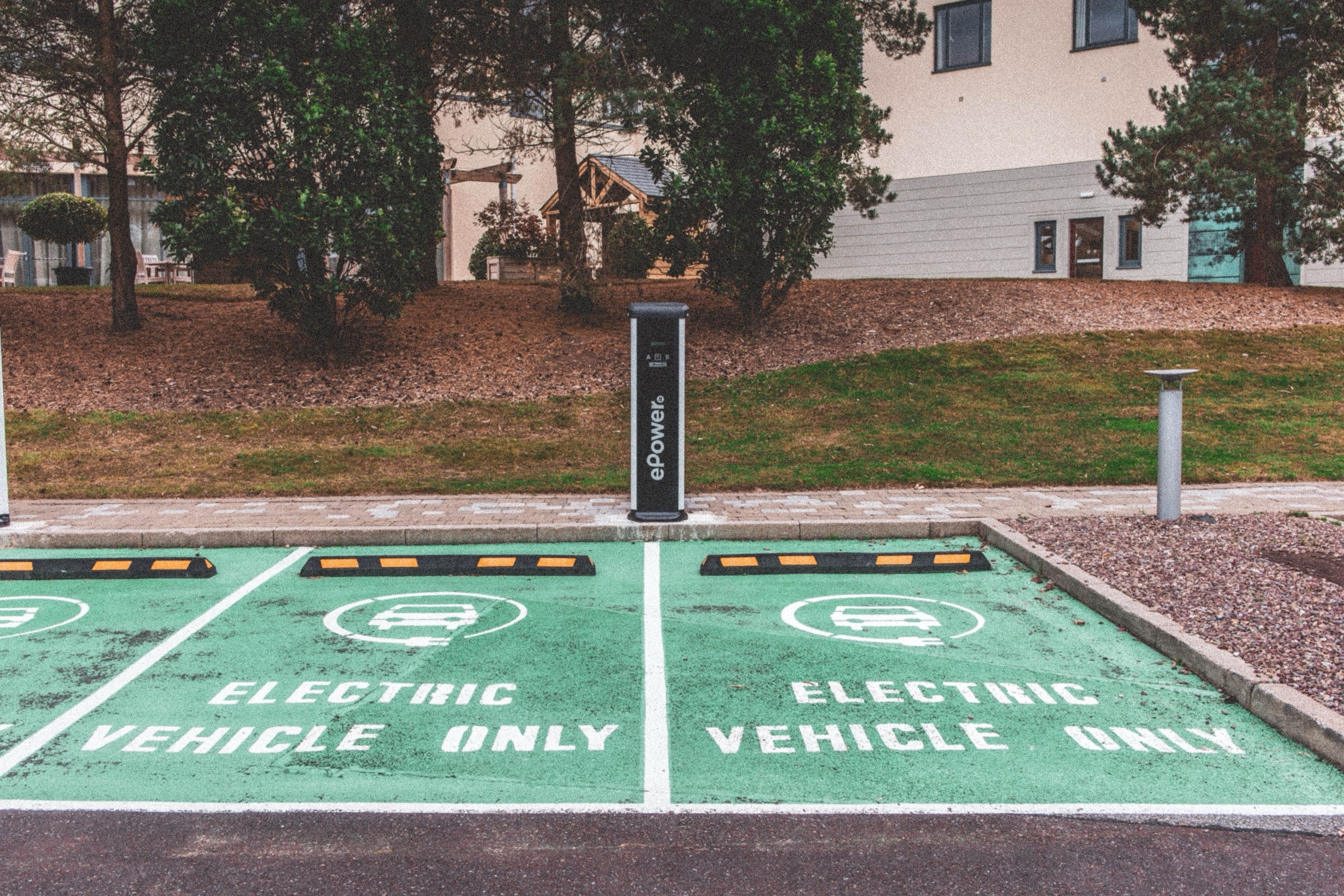
Green parking bays for electric cars with a charging postFot. Craig Adderley

Ten 11 kW chargers add up, in theory, to 110 kW — more than many buildings have available. And yet they can be connected without increasing the grid connection capacity. This is made possible by charger load balancing, i.e. dynamic power management: the system continuously shares the available power among the cars that are actually charging. We explain how it works, how many points will fit on a connection and whether drivers will notice any difference.

The problem: the chargers’ total power

Without load management, every charger has to be supplied as if they were all running at full power at the same time. With just a few points, it quickly turns out that the spare capacity in the connection and switchboard is not enough, and the only way forward is to increase the connection capacity — with a connection fee, a new contract and often months of waiting for the grid operator.

In practice, however, chargers almost never all run at full power at once. Cars arrive at different times, with different battery levels, and many of them charge more slowly than the charger allows. Reserving power “just in case” means paying for a connection that stands unused most of the time.

How load balancing works

The system is given a power limit for a group of chargers and splits it among active sessions in real time. When one car is charging, it gets the charger’s full power. When more cars plug in, the power is spread between them, and the total never exceeds the limit. When one car finishes charging, the freed-up power immediately goes to the others.

  • Static power sharing — the charger group has a fixed limit, e.g. 44 kW, set in the design. Simple and safe, but it does not use power the building does not need at a given moment.
  • Dynamic power sharing (DLB) — the system continuously measures the consumption of the whole building (lifts, lighting, air conditioning, commercial units) and gives the chargers whatever is left up to the connection limit. At night, when the building uses little, cars get more; at peak times — less.

Example: 8 chargers on 44 kW

A garage has 8 AC chargers of 11 kW, and the design allocates 44 kW to them in total. Without load management, 88 kW would be needed. With load balancing:

  • 1–4 cars — each charges at the full 11 kW.
  • 6 cars — each gets approx. 7.3 kW.
  • 8 cars — each gets 5.5 kW. Over 10 hours of overnight parking, that is 55 kWh, i.e. enough energy for several hundred kilometres — more than most drivers use in several days.

Illustrative calculation: the actual power limit results from an analysis of the building’s grid connection and installation, and charging power also depends on the car’s own capabilities.

Does charging slow down?

With overnight parking at an apartment block or all-day parking at an office, power sharing is usually unnoticeable — the car still has time to charge. A driver who comes home in the evening with a low battery has a full or nearly full battery in the morning, regardless of how many cars were charging alongside.

It does matter for short stays, however, e.g. at a retail car park. In that case, it is worth planning a higher power limit or setting priorities so that cars with short stays get more.

Priorities, schedules and phases

  • Priorities — e.g. fleet cars that head out on the road in the morning can get power before employees’ private cars.
  • Schedules — charging at times when the building uses little energy or a cheaper night tariff applies.
  • Group limits — separate limits for garage zones, buildings on an estate or chargers supplied from different switchboards.
  • Phase balancing — cars charging on a single phase load only one phase; spreading them across different phases makes better use of the connection.

What you need

  • Chargers that support load management — ideally via the open OCPP protocol, which lets the system set the power of each session remotely, regardless of the manufacturer.
  • For dynamic sharing — metering of the building’s consumption, e.g. a meter or current transformers on the supply, from which the system reads the current load.
  • A permanent connection between the chargers and the system — also in an underground garage, e.g. via an M2M SIM card.
  • Safe fallback settings — if the connection is lost, chargers should switch to a low, safe default power instead of running without a limit.
  • An installation design — load balancing does not replace correctly sized cables and protective devices. The power limit is set by the designer based on an assessment of the installation.

What the investor gains

  • More points on the existing connection — without an expensive and lengthy increase in connection capacity.
  • Protection of the installation against overload and tripping during the building’s peak consumption.
  • Phased expansion — additional chargers are added to the same group, without rebuilding the power supply.
  • Better use of your own energy — dynamic sharing can take into account generation from rooftop photovoltaics.

Frequently asked questions

  • It can temporarily reduce the power per point when many cars are charging at once. With overnight or all-day parking, this is practically unnoticeable — the car still has time to charge.

Related services

We handle the entire process turnkey — see how we can help:

Sources

Read also

Have a question about charging at your property?

Let’s talk

Let’s talk about working together

Call or write — we’ll answer your questions about assessment, installation and charger billing. You can also leave an enquiry in the form beside this.

I am interested in:

You can select several options.

Provide it if you are enquiring on behalf of a housing community or company. Individual clients can leave it blank.

Leave a number if you prefer a call. Otherwise we will reply by e-mail.

Tell us about the project: type of property, number of charging points, location. It helps us prepare a quote.