
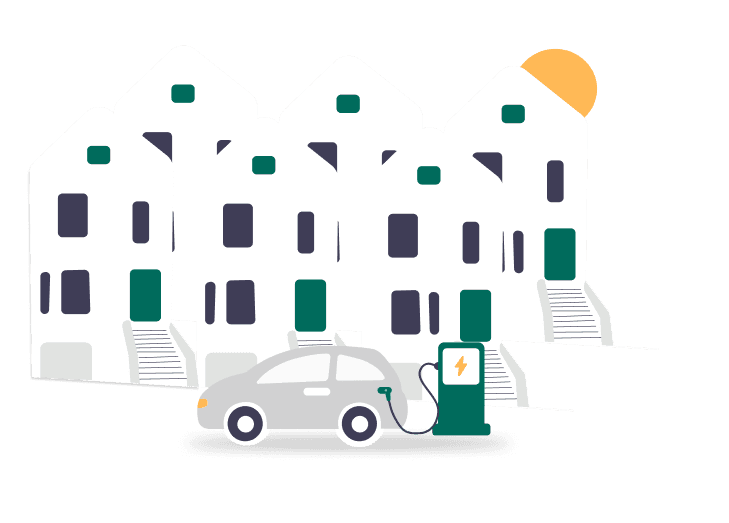
EV chargers for HOAs and housing co-ops: development plan and turnkey delivery
We prepare an e-mobility development plan for the whole multi-family building and deliver it end to end: expert reviews, designs, new grid connections, charger installation, dynamic load balancing that uses solar PV energy, and remote billing for boards and residents. We also handle the UDT documentation and fire-safety verification, advise boards on which direction to take e-mobility, and after commissioning provide periodic inspections and service.

End-to-end EV charging service for HOAs and housing co-ops
One partner for the whole journey: from advice and a development plan, through expert reviews, designs and connections, to installation, UDT acceptance, billing and service.
E-mobility development plan
We work out how many charging points are needed now, what reserve to leave for the future and in what order to expand the building’s infrastructure — so that later stages need no rework.
Expert reviews and designs
We assess the building’s electrical installation and connection capacity, then design the charger installation with an administrative meter and a MID-certified submeter for each point.
New building connections, rising mains and switchboards
When the building’s current capacity is not enough, we design and build a new connection to the building together with the rising main and switchboards for the chargers — sized for the development plan, not just for the first cars.
Dynamic load balancing
The chargers draw on a shared power pool that the system continuously distributes among the cars being charged. The connection is never overloaded, and the building can run more chargers on a lower connection capacity.
Solar PV self-consumption
We connect the chargers to the building’s PV installation so that cars charge from solar energy first. Self-consumption goes up and charging gets cheaper for residents.
Installation and commissioning
We install the chargers, MID submeters and accessories, commission dynamic load balancing and configure the system — tariffs, users and access to the chargers.
Remote billing for boards and residents
Software for remote reading of MID submeters and charging sessions, with a panel for the manager and billing of each resident — no commission on energy.
UDT documentation
We prepare the complete documentation for the technical inspection and acceptance of the installation by the Office of Technical Inspection (UDT).
Fire-safety verification
We verify the installation and the mounting location for fire safety, including an opinion from a certified fire-safety expert.
Periodic inspections
We carry out periodic inspections of the chargers and the installation with electrical measurements and reports that document its safe condition.
Service and maintenance
We monitor the chargers remotely, diagnose and fix faults, and response times are guaranteed by an SLA — so residents can charge without interruptions.
Advice for boards
We help boards choose the charging model — individual chargers or rotational hubs — plan the investment in stages and set usage rules for residents.
What matters most to a homeowners’ association
The three things the board and residents care about — and which we design for from the very first conversation.
Cheap and fair billing
A MID-certified submeter measures each charger, and the cost of energy goes to the specific resident. The association pays nothing extra, and each resident pays only for their own kilowatt-hours — with no commission on energy sales, in a simple per-point subscription.
A well-thought-out, coherent solution
One design and one contractor for the whole building instead of ad-hoc hook-ups ordered by individual residents. Chargers, connection, billing and service form one system, and you add further points in stages without repeating the whole procedure. A well-thought-out design means well-thought-out e-mobility growth.
Safety
Fire-safety verification, selection of protection and preparation for the UDT inspection for the whole installation. Dynamic load balancing protects the connection from overload even with several cars charging at once, and periodic inspections confirm that the installation stays safe.
How EV charger installation works in an HOA — step by step
We start not with the hardware but with the needs and the development path of the whole building.
Analysis and advice
We analyse the building and the residents’ needs, advise on the direction of development and define the number of charging points for now and a reserve for the future.
Development path
We choose the model: individual chargers under dynamic load balancing on the ADM meter, or internal AC charging hubs for rotational charging.
Expert reviews and design
We carry out expert reviews and the design — including a new connection, rising main and switchboards if needed — with MID submeters, dynamic load balancing and PV integration. We verify the installation for fire safety and prepare the UDT documentation.
Installation and commissioning
We build the connection and rising main if needed, install the chargers and commission the whole system.
Billing, inspections and service
We read and bill charging remotely, carry out periodic inspections and provide service.
We take on the formalities and safety. See the details of the fire-safety review and UDT inspection, as well as the scope of installation and service.
Individual or shared chargers? Two development paths
Together we choose one of two paths — or combine both as the number of electric cars grows.
Individual chargers with dynamic load balancing (DLB)
Every interested resident has their own charger at their space, but all of them are connected to a single administrative (ADM) meter and covered by dynamic load balancing. The system shares the available power among the cars currently charging, and a MID submeter measures each point’s consumption.
Thanks to DLB we lower the simultaneity factor: instead of reserving power 1:1 for every charger, we apply a multiplier (e.g. 0.4). That genuinely reduces the required connection capacity and the cost of the connection.
Internal AC charging hubs for rotational charging
Instead of a dedicated space for everyone, we install a shared hub of AC chargers that residents use in turn. The system manages access and the queue, and we read and bill each session remotely — everyone pays only for their own charging.
A single rotating socket can serve up to 7 electric cars in an association without creating queues — far cheaper than a separate charger for each.
Whichever path you choose, for the whole association it is more advantageous to carry out one collective expert review and adopt a shared development plan than to connect each resident separately. More in the article Collective expert review and a group of chargers, and we describe the scope of the formalities on the fire-safety review and UDT inspection page.
Software for the property manager: remote reading and commission-free billing
We provide a system in which the manager of an HOA or housing co-op runs all charging in the building from one panel — both individual chargers with dynamic load balancing and in-house chargers available to every resident.
No commission on energy
You pay a fixed monthly subscription per charging point. We take no commission on energy sales — all charging fees stay with the association.
Chargers with load balancing
Residents’ individual chargers on a shared administrative meter: the system distributes the power, and the panel shows power usage and charging peaks.
In-house chargers for every resident
Shared chargers in the garage that any authorised resident can use. Residents see free and busy connectors, and every session is assigned to a specific person.
Remote reading
Readings of MID submeters and all charging sessions reach the panel automatically — no walking round the garage and no manual meter reading.
Tariffs and access
The manager sets the price per kWh (e.g. flat or day/night) and grants access per flat, building or charger.
Reports for re-invoicing
Statements of energy consumption, costs and number of sessions per user — ready for re-invoicing.
Domena Power system pricing
A simple subscription for every charger, with no commission on energy sales.
Domena Power charges a monthly subscription for connecting chargers to the system. We take no commission on energy sales, so all the revenue stays with you.
Calculate the monthly system fee
We will work out the net and gross amount incl. 23% VAT for your number of chargers.
Number of chargers (sockets)
First socket 30 zł, each additional +10 zł net/month.
External connectivity (LTE SIM cards)
When the charger has no access to the site internet. First card free, each additional +10 zł net/month.
How much do EV chargers for an HOA cost? Investment and service quotes
Every building is different, so we quote the investment and the service with inspections individually — after assessing the building and the number of points. You can calculate the billing-system subscription in the calculator above.
Turnkey investment
Individual quote
Expert reviews and design, a new connection with rising main and switchboards if needed, MID submeters and dynamic load balancing (also with PV energy), installation of the chargers, fire-safety verification, UDT documentation and configuration of the billing system. The cost depends on the building, the development path and the number of points.
 One collective documentation and development plan for the whole building
Service and inspections
Individual quote
Periodic inspections with measurements and reports, fault diagnostics and service with guaranteed response times (SLA). The quote depends on the number of chargers and the location of the building.
Full care of the installation: from inspections to repairs
EV chargers in HOAs and housing co-ops — FAQ
- Individual means a dedicated charger at the space of each interested resident, connected to a shared administrative meter with dynamic load balancing. A rotational AC hub is a shared set of chargers used by residents in turn — a single socket can serve up to 7 cars without queues. In both models, everyone pays only for their own charging.
- No. We connect the chargers to a single administrative meter with dynamic load balancing (DLB), which shares the available power among the cars currently charging. Instead of reserving and locking power 1:1, we apply a simultaneity factor (e.g. 0.4), so the required connection capacity is much lower.
- It is a certified energy meter compliant with the MID directive, fitted at each charger. It measures the actual consumption of a given space, so billing is accurate to the kilowatt-hour and can be used for rebilling.
- No. We assign the cost of energy to the specific user based on the MID submeter and session metering, so everyone pays for their own and the association doesn’t chip in.
- Yes. Installation in a multi-family building requires the association’s consent and an analysis of the impact on the electrical installation and fire safety.
- In most cases, yes. The UDT technical inspection requires an opinion from a fire-protection expert. We deliver it as part of our expert reviews.
- Definitely collective. One review and design for the whole building, plus an adopted e-mobility roll-out plan, are cheaper and more consistent and let you add further points without repeating the procedure. Separate reviews for each resident duplicate the cost of analysing the same building and quickly exhaust the available power.
- First we check how many points the existing connection can handle with dynamic load balancing. If that is not enough for the planned number of chargers, we design and build a new building connection together with the rising main and switchboards, with a power reserve for later stages of the development plan.
- Yes. If the building has a PV installation or is planning one, we include it in dynamic load balancing — surplus solar energy goes to the charging cars first. Each resident is still billed based on their MID submeter.
- Based on data from the system. Every charging session is assigned to a specific resident and measured by a MID submeter, so the board re-invoices energy according to actual consumption — no estimates and no manual readings.
- Yes. Installation, periodic inspections and service under an SLA are part of our offer — you can order them together with the whole turnkey investment or separately, also for existing chargers.
Want a well-thought-out charger project for your association?
Arrange a callLet’s talk about working together
Call or write — we’ll answer your questions about assessment, installation and charger billing. You can also leave an enquiry in the form beside this.