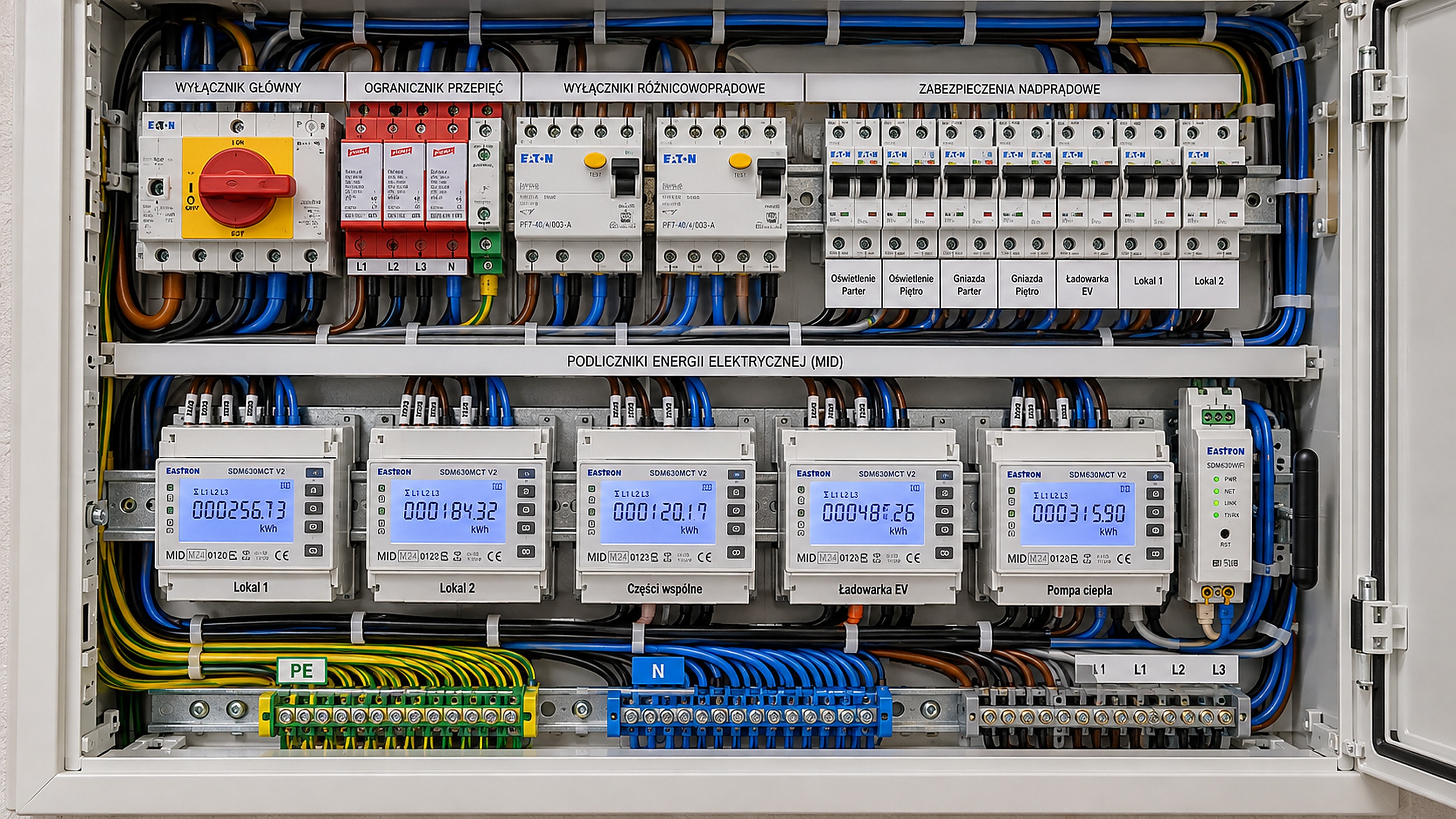
The first resident with an electric car usually asks about their own charger. A year later there are five people asking, and every separate installation means more cables, more documentation and less and less spare power. Preparing the building collectively reverses the order: the housing community builds shared infrastructure once, behind the building’s common-area (administrative, ADM) meter, and chargers are added in stages. We explain what this model delivers: more points on the same grid connection, energy from the community’s photovoltaics in residents’ cars, and a charging tariff under which everyone pays only for their own charging.
What does collective preparation of a building involve?
Instead of considering each charger separately, the housing community or housing co-op commissions a single design for the whole garage or car park. The result is shared infrastructure to which a charger can later simply be plugged in at the space of the next interested resident.
- Power assessment: how much headroom the common-area connection has and how the building uses energy over the course of the day.
- A collective assessment and design for the target number of points, including a fire-safety review of the garage.
- A charger switchboard supplied from behind the administrative meter, and cable routes run along the parking spaces.
- Dynamic load balancing (DLB), which makes sure the chargers do not exceed the power available to the building.
- A MID submeter — a meter certified under the EU Measuring Instruments Directive — at every point, and a system that assigns consumption to the resident.
- A resolution and regulations: who can join, who pays for what, and at what rate energy is billed.
Chargers behind the ADM meter: what does it give you?
The administrative (ADM) meter is the meter for the building’s common areas — the same one that supplies the lighting, lifts and garage ventilation. Connecting all chargers behind this single meter has several practical advantages:
- No new connections. The building’s existing grid connection is used, so there is no application to the grid operator, no waiting for connection conditions and no separate energy contract for each resident.
- One infrastructure instead of many cables. A shared switchboard and cable routes replace wiring pulled from individual flats’ meters through stairwells and ceilings — and every such crossing of a fire zone boundary has to be sealed separately.
- A shared pool of power. Dynamic load balancing only works when the chargers sit behind one meter and the system can see the total load.
- Energy from the community’s photovoltaics goes into the cars. The PV installation is connected behind the common-area meter, so only chargers behind the same meter will use its surplus.
- A potentially better tariff. The common-area meter of a residential building in Poland is usually billed in tariff group G — the same group as households. Whether it stays there once chargers are added is assessed by the energy supplier and the grid operator, so we confirm this before the design.
- A lower entry cost for the resident. They pay for their own charger with a submeter and a short length of cable, not for an entire installation from scratch.
- Oversight of safety and inspections. The shared charger installation is part of the building’s electrical installation, so the property manager keeps it under control: one set of documentation, joint measurements and periodic inspections, and a single link to the safety systems — the fire-fighter’s power cut-off switch and the fire alarm system. With chargers fed from individual apartment meters, each installation is private and its inspections are hard to enforce.
The condition for success: reliable metering. Since the charging energy passes through the community’s meter, every point must have a MID submeter, and billing must follow clear rules. Otherwise the cost of someone else’s charging ends up with everyone.
Option 1: one ADM meter for the whole common area
The chargers are connected to the existing common-area meter — the same one that covers lighting, lifts and the garage, usually in tariff group G. This is the simplest option.
- Metering point: the existing common-area meter, with no application to the grid operator, no new contract and no additional fixed charges.
- Power: dynamic load balancing takes the load of the whole building into account and passes on to the chargers the power that the lifts or lighting are not using at that moment.
- Photovoltaics: the community’s installation sits behind the same meter, so its surplus goes into the cars.
- Billing: charging energy and common-area energy are on one invoice.
- Tariff: one tariff and one contracted capacity for the building and the chargers.
- Requirement: every point must have a MID submeter, and billing must be based on its readings.
- Requirement: the tariff group must be confirmed with the supplier once chargers are added, because a change would apply to the whole meter.
Option 2: an additional ADM meter just for the chargers
The community applies for a second metering point dedicated solely to the chargers. The chargers still form one group with dynamic load balancing and MID submeters, but they have their own meter and their own invoice.
- Metering point: a separate meter and a separate energy contract for the chargers.
- Power: dynamic load balancing works within the capacity of this meter, independently of the load of the rest of the building.
- Photovoltaics: an installation connected behind the main common-area meter does not feed the electric cars directly. Its surplus goes to the grid, while the chargers draw energy through their own meter.
- Billing: the invoice from this meter covers charger energy only, so the submeter total should match the bill.
- Tariff: its own tariff, which can be chosen for charging (e.g. a two-rate tariff with a cheaper night rate), independent of the bills for lifts and lighting.
- Requirement: an application to the grid operator for a new metering point — with waiting time, the cost of metering equipment or a connection, and additional fixed charges.
- Requirement: a MID submeter at every point, to split the energy between residents.
- Requirement: confirmation of the tariff group with the supplier. A meter that feeds only chargers may be classified differently from the common-area meter.
Which option should you choose?
A single ADM meter works well when the community has photovoltaics or limited spare capacity and wants to use every free kilowatt-hour of the building. A separate meter is worth considering when many points are planned, the community wants a hard separation of charging costs from common-area costs, or additional capacity has to be applied for anyway.
In both options the resident pays only for their own consumption according to the submeter. The choice affects the investment cost, the number of possible points and the way billing is run — which is why we settle it at the power assessment and design stage.
Dynamic load balancing: more points on the same connection
With a rigid allocation, each charger permanently locks its full power, even when nobody is charging. The power headroom runs out after a few points and the next residents are turned down. Dynamic load balancing (DLB) measures the building’s current load and shares the free power between the cars that are actually charging at that moment.
Example: a building has 40 kW of headroom. With a rigid allocation of 11 kW per point, 3 chargers will fit. With DLB and a simultaneity factor of 0.4, the same headroom will serve around 9 points of 11 kW each — and at night, when the lifts and lighting draw very little, the system also hands the building’s free power over to the chargers.
For the resident, this means the car charges more slowly at peak times but is fully charged by morning. For the housing community — that there is no need to increase the connection capacity or pay for exceeding it.
An illustrative calculation. The available headroom and the simultaneity factor are determined by the designer after a power assessment of the specific building.
Community photovoltaics and the tenant prosumer
Since 1 October 2023, housing communities and co-ops in Poland have been able to operate as a tenant prosumer (prosument lokatorski) — a Polish legal scheme. A photovoltaic installation on a multi-unit building (up to 50 kW and no more than the building’s connection capacity) is connected behind the common-area meter. Energy used in the same hour in which it was generated costs nothing. Surpluses are converted at the market price into a prosumer deposit and paid out to the community in full (100%) — they can be used to pay energy bills or to lower residents’ charges.
The trouble is that the market price at midday on a sunny day can be very low, while the common areas use little energy during the day. Chargers behind the same meter change that equation: the cars take up the energy from the roof on site, before it goes to the grid for a fraction of the price.
- Every kWh from the roof used in a car is worth as much to the community as purchased energy costs — not as much as selling to the grid brings in.
- The community can bill the resident for this energy at the grid purchase price: the resident does not overpay, and the difference stays in the building’s budget.
- Higher self-consumption means a faster payback on the photovoltaic installation.
Photovoltaics is not a prerequisite — the model with an ADM meter and DLB also works without it. The call for applications for the RES Grant (Grant OZE — a subsidy of up to 50% of installation costs) closed on 30 June 2026; we check the currently available support programmes at the design stage.
The ADM meter tariff: what does the community pay for energy?
Two different tariffs are at work in this model. The first is the tariff group of the ADM meter, i.e. the price at which the community buys energy from the supplier. The common areas of residential buildings — lighting, lifts, heat substations, garages in which no business activity is carried out — are billed in group G, the same as households.
The community can choose a single-rate tariff (G11) or a two-rate one (e.g. G12w), which is cheaper at night and at weekends. Car charging shifts consumption to precisely those hours, so once the chargers are up and running it is worth recalculating the tariff.
The tariff group for a specific meter is set by the energy supplier and the grid operator based on how the energy is actually used. The definition of group G does not explicitly mention vehicle charging, and it requires that no business activity is involved — which is why residents are billed on a cost-recovery basis, not with a margin. We confirm the classification with the supplier before the chargers go live.
The charging tariff: what do residents pay?
The second tariff is internal. By charging tariff we mean the rate per kWh at which the community bills residents for charging behind the ADM meter. It is not an official tariff group of the energy supplier, but a price list set by a resolution or regulations and entered into the billing system.
- What it consists of: the price of energy and distribution from the community’s invoice, plus — if the community so decides — a share of the infrastructure upkeep costs (system subscription, inspections).
- No margin and no commission: the resident pays a rate close to the household one, clearly lower than at public chargers, and the community recovers its cost down to the kilowatt-hour.
- Options in the Domena Power system: a fixed price per kWh or a two-rate tariff — with a cheaper rate at night or during the hours of photovoltaic generation. A dynamic tariff based on market prices (RCE, the Polish market energy price) will be available soon.
- Separate rates for people from outside the community, e.g. guests or tenants of commercial units, if the community makes charging available to them.
- Transparency: the resident sees the price and cost of every session in the app, and the property manager receives a statement for service charges or debit notes.
Who pays for what?
- Shared infrastructure (assessment, design, switchboard, cable routes, DLB) — the community or a group of interested residents; the cost-sharing rules are set by a resolution.
- The charger with a MID submeter and its connection — the resident who uses it.
- Energy — each resident according to the readings of their own submeter, at the charging tariff.
- Billing system — a fixed subscription per charger, with no commission on energy.
How do you prepare a building step by step?
- Assessment of power and needs: connection headroom, number of spaces, residents’ interest today and in a few years’ time.
- Collective assessment and design for the target number of points.
- A resolution and charging regulations, including the charging tariff and the rules for sharing infrastructure costs.
- Construction of the shared infrastructure for the target number of points.
- Installation of chargers in stages — as the number of electric cars grows.
- Launch of the billing system and handing residents access to the app.