Domena Power
Charging in practice

Your own charging operator: billing with no commission

5 min readupdated

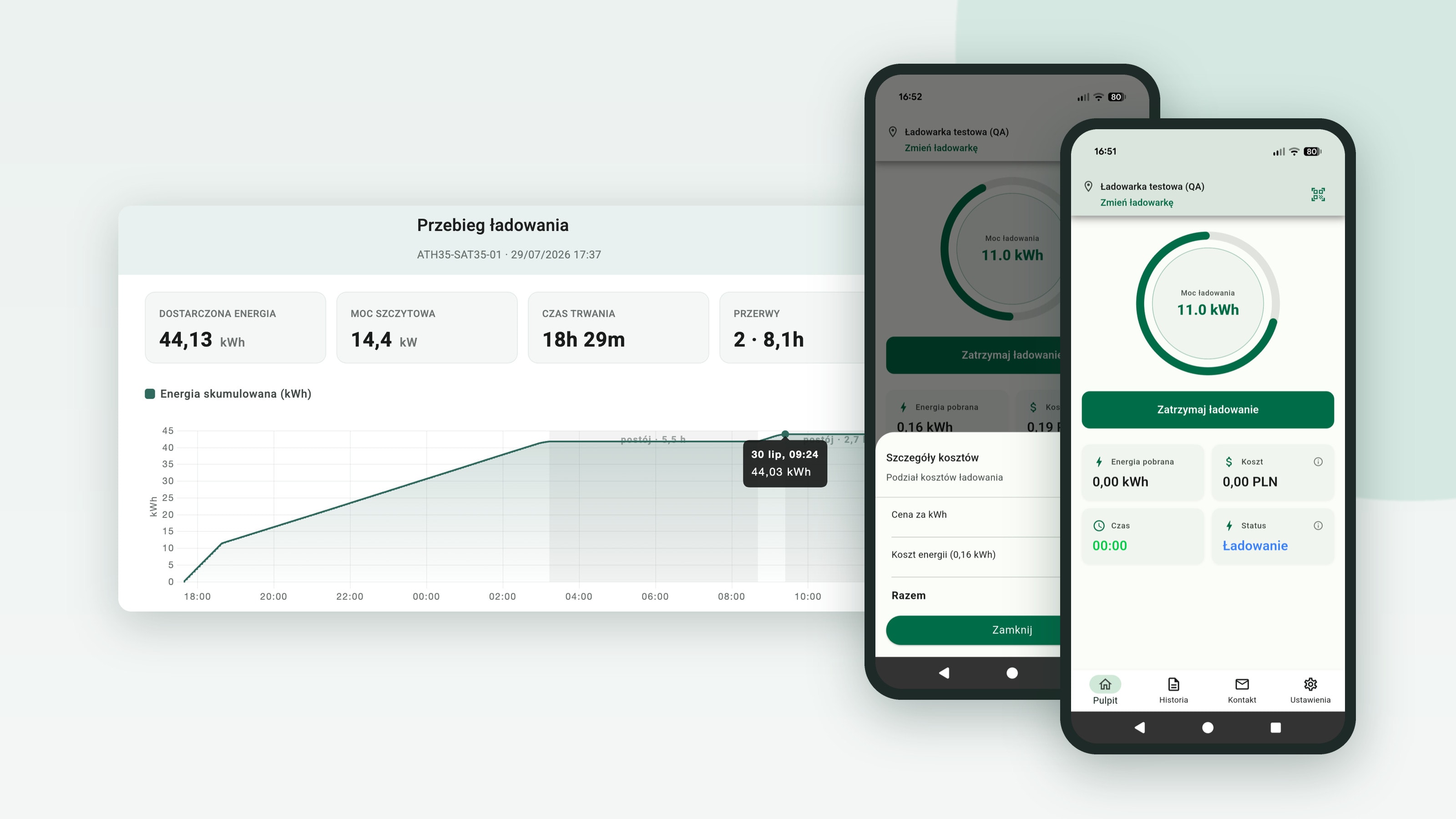
Domena Power system: a charging session in the operator panel and app screens showing charging power and cost details

The chargers at your site don’t have to belong to an external network that takes a commission on every kWh and dictates the price list. With your own charger billing system, you are the operator: you set the rates and access rules, while the system takes care of authorisation, charges and reports. We explain how it works, how much you can save and which formalities apply in Poland.

What it means to be your own charging operator

A charging operator is the entity that decides how the stations are used: who can charge, at what price and how they are billed. In the external-network model, you hand these decisions — and part of the revenue — over to an intermediary.

In a closed system, the operator is the owner or manager of the site: a housing community, a developer, a hotel, an office building or a company. Domena Power supplies the software that handles authorisation, charges and reports, but does not become a party to the settlement with users and takes no commission on energy.

Commission or subscription: how much you keep

The commission model grows with charger usage — the more kWh, the more you give away. A subscription is fixed and does not depend on how much energy you sell.

Example: 8 chargers, each averaging 300 kWh a month, at a rate of 1.50 zł/kWh. That is 3,600 zł of revenue a month. With a 20% commission, the intermediary takes 720 zł. The Domena Power subscription for 8 chargers is 100 zł net a month (30 zł for the first and 10 zł for each additional one), and the first M2M SIM card is included in the price.

The calculation is illustrative: the commission rate depends on the network operator and consumption depends on the site. You will find the current system price list and calculator below.

What you control as the operator

  • Rates and tariffs: free charging, a fixed price per kWh or a two-zone (day/night) tariff; a dynamic tariff based on market prices (RCE, Poland’s market energy price) will be available soon.
  • Access: who can charge — per charger, location, unit or building — and roles in the panel (e.g. administrator, operator, reception).
  • Authorisation: via the user app or remotely from the panel, e.g. for hotel guests without creating accounts.
  • Reports: energy consumption, costs, number of sessions and load over time — ready for billing residents, tenants or employees.
  • Power: limits per site or charger group and dynamic load balancing, if deployed.

Payments straight to your account

Soon you will be able to connect a payment provider, so session fees go directly to the site’s account — with no intermediary in the flow of money. Until then, the charges calculated by the system are used for your own billing, e.g. in residents’ service charges or on tenants’ invoices. We also integrate with property administration and billing systems (including Betasi), hotel systems and BMS (building management systems).

Formalities: licence, UDT and EIPA

  • Licence — when it is NOT needed: under Polish law, providing an EV charging service at a charging point — even for a fee and even when the price is set per kWh — does not constitute a sale of electricity within the meaning of the Energy Law. The charging service itself therefore does not require an electricity trading licence. This applies both to publicly accessible stations and to stations operating in closed systems.
  • Licence — when it MAY be needed: if, in addition to providing the charging service, an entity buys electricity and resells it to customers for other purposes, this model may constitute electricity trading that requires a licence. Distributing electricity to other entities also requires a separate analysis.
  • Your own RES source: a micro RES (renewable energy source) installation has a capacity of up to 50 kW. An installation above 50 kW and no larger than 1 MW is a small RES installation; operating it does not require a generation licence but, as a rule, requires entry in the register of small-installation generators kept by the President of URE (Poland’s Energy Regulatory Office). For larger installations, a generation licence is generally required.
  • UDT: technical inspections by UDT (Poland’s Office of Technical Inspection) apply to charging stations within the meaning of the Electromobility Act — both publicly accessible and non-public ones, if they are used to provide a charging service. The initial inspection is carried out before the station is put into operation. A repeat inspection may be required, among other things, after a repair, an upgrade, an increase in the number of charging points or a change in their location. Not every private charger is automatically subject to a mandatory UDT inspection.
  • EIPA: publicly accessible charging stations are registered in EIPA (Poland’s Alternative Fuels Infrastructure Register). Stations operating in closed systems that are not publicly accessible are not required to be registered in EIPA.
  • Taxes: the approach to VAT, excise duty and invoicing for the charging service should be tailored to the specific business model, the legal form of the site and the status of the entity providing the service.

We confirm the scope of formalities for each specific site — it depends on how the chargers are made available and whether charging is paid.

How to become your own operator

  • We check your chargers: the system works with any device that supports the OCPP protocol, regardless of manufacturer.
  • We provide connectivity — including in underground car parks, via an M2M SIM card.
  • We configure the site in the panel: chargers, users, permissions and tariffs.
  • Users charge via the app, and you get a real-time view of sessions, consumption and charges.

Calculate the monthly system fee

We will work out the net and gross amount incl. 23% VAT for your number of chargers.

Number of chargers (sockets)

First socket 30 zł, each additional +10 zł net/month.

1

External connectivity (LTE SIM cards)

When the charger has no access to the site internet. First card free, each additional +10 zł net/month.

0
Chargers (1)30 zł
Total net / month30 zł
VAT 23%6,90 zł
Estimated gross / month36,90 zł incl. 23% VAT
Book a call
* Charger group:chargers operating at the same address, connected to the same internet network,chargers in the same site, connected via M2M IT Easy cards.An LTE SIM card is needed when the charger has no access to the site internet. We confirm the final number of cards during the quote.

Frequently asked questions

  • A public network usually takes a commission on energy and dictates the price list. As your own operator, you set the rates and access rules yourself and pay a flat subscription for the system.

Related services

We handle the entire process turnkey — see how we can help:

Sources

Read also

Have a question about charging at your property?

Let’s talk

Let’s talk about working together

Call or write — we’ll answer your questions about assessment, installation and charger billing. You can also leave an enquiry in the form beside this.

I am interested in:

You can select several options.

Provide it if you are enquiring on behalf of a housing community or company. Individual clients can leave it blank.

Leave a number if you prefer a call. Otherwise we will reply by e-mail.

Tell us about the project: type of property, number of charging points, location. It helps us prepare a quote.