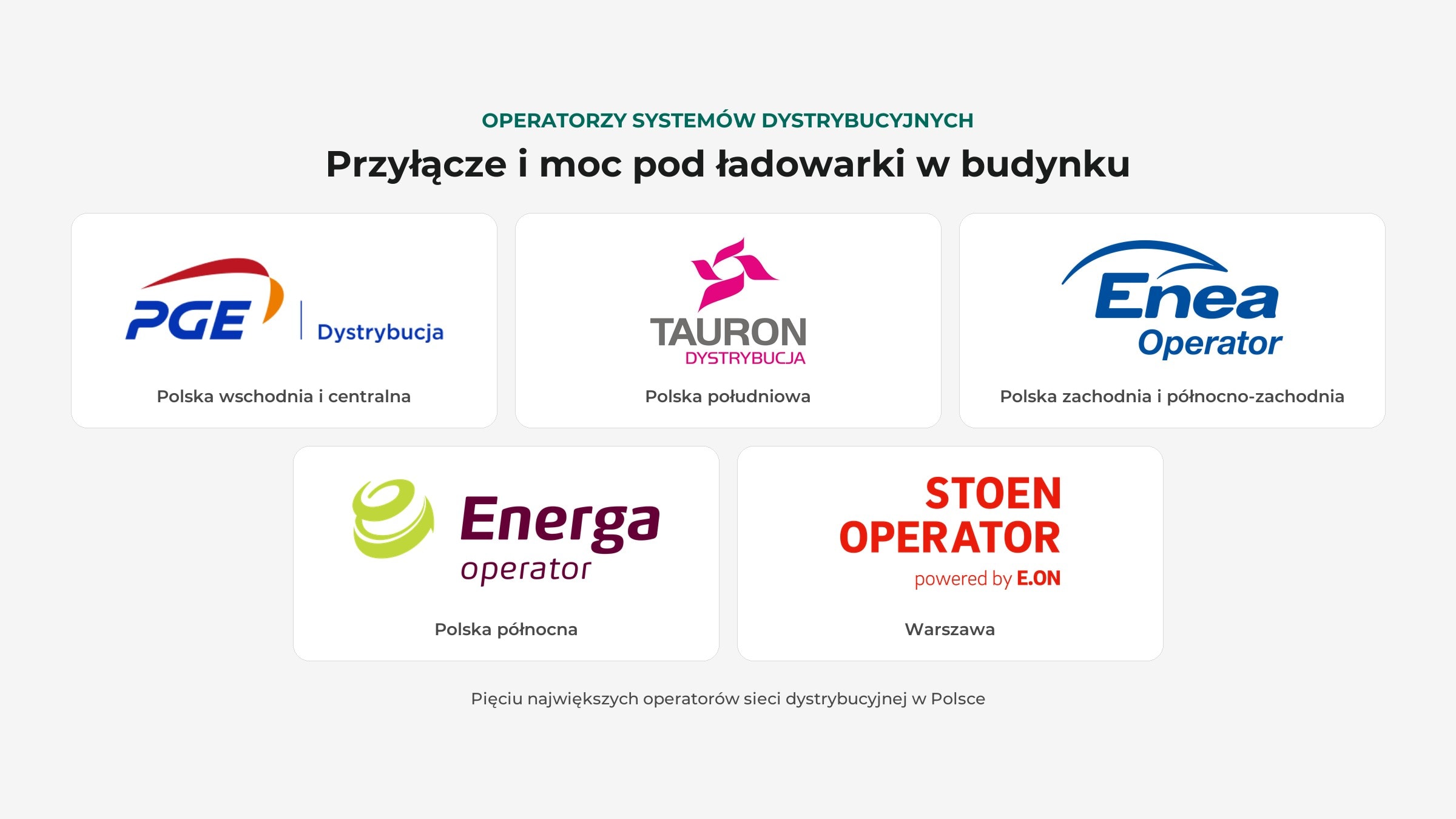
In a multi-family building, a charger is rarely a matter for one resident and their meter. The supply almost always runs through the common-area installation, and the capacity of the whole building is limited by the connection, for which the housing community or housing co-op is responsible. Before anyone submits an application to the distribution system operator (DSO, in Polish OSD), you need to know how much spare capacity the building has, where to supply the chargers from and who is the party dealing with the operator. We explain what the whole procedure should look like, why it cannot be carried out reliably without an assessment and a design, and what each of the five largest DSOs requires.
Who deals with the DSO in an apartment block
The connection agreement for the building and the contract for the common areas are held by the housing community or housing co-op. It is its board or property manager that submits an application to the DSO for an increase in the building’s capacity or for an additional metering point. A resident has their own meter in their flat, but the garage is usually several floors below, so the charger cannot simply be connected to “their own” electricity.
A resident who wants a charger just for themselves follows the route set out in the Electromobility Act: an application to the board, an assessment, consent. In practice, chargers in an apartment block are supplied in one of four ways:
- From the common-area installation, with a MID submeter at the charger — consumption is billed by the property manager. If the building’s capacity is sufficient, no application to the DSO is needed.
- With a separate DSO meter for the resident’s charger — once the charging point has been installed in the parking space and a contract with the operator has been concluded, the DSO installs a metering system (Article 12b(10) of the Electromobility Act). The power still comes from the building’s connection.
- From an additional metering point (PPE) of the housing community for the garage or all the chargers — since 30 April 2026 without new connection conditions, as long as the total capacity fits within the building’s connection capacity.
- After increasing the building’s connection capacity — when none of the options above is sufficient. The housing community or co-op then submits an application for connection conditions.
Contracted capacity or connection capacity
For the common areas, two values in the contract with the DSO matter: the connection capacity, i.e. the maximum the connection provides, and the contracted capacity, i.e. how much the housing community has ordered. If the chargers fit within the connection capacity, it is enough to increase the contracted capacity — the application is submitted to the DSO, or, under a comprehensive contract, through the energy supplier. In connection groups IV and V the change takes effect after 2 months at the latest.
Only when the connection capacity runs out do you need an application for connection conditions, a connection agreement and a connection fee. The group is determined by capacity: group V is a connection to the low-voltage grid with capacity up to 40 kW, group IV — above 40 kW.
What to do before you apply to the DSO
An application to the DSO is one of the last steps, not the first. The operator asks for specific figures — the building’s capacity with simultaneity factors, the installation diagram, the number and power of the chargers — which the board does not know without preparation. A sensible order looks like this:
- Gather demand: a short survey among residents will show how many want to charge now and within the next few years. This determines whether you plan individual chargers or shared infrastructure.
- Gather the documents: the connection agreement or connection conditions (connection capacity), invoices (contracted capacity), the design of the building’s electrical installation, the report from the last five-yearly inspection of the electrical installation, the switchboard diagram and the garage’s fire safety instructions.
- Measure the actual load: a measurement or the power profile from the meter shows how much power the building really uses at peak times and how much is left for charging.
- Commission an assessment: it will establish how much of the building’s capacity can be allocated to charging, where and with what protective devices the chargers can be connected, and which fire-safety requirements must be met. On this basis you choose the option: power management within the current capacity, a change of contracted capacity, an additional metering point or an increase in connection capacity.
- Make decisions in the housing community: consent to a resident’s charger with a power below 11 kW is given by the board, but shared infrastructure or an increase in the building’s capacity financed by the housing community usually requires a resolution — preferably one that sets out the financing and authorises the board to submit the application and sign the connection agreement.
- Prepare a design: a power balance with simultaneity factors, a single-line diagram, cable routes, the location of the chargers and metering systems, and the charger data. Most of the information the DSO asks for comes from it.
- Only now submit the application to the DSO — on the operator’s current form, with a complete set of attachments.
Why you need an assessment
In a multi-family residential building with more than three units, a feasibility assessment is mandatory before consent is given to a resident’s charger: the board commissions it within 30 days of the application, and the cost is borne by the applicant (Articles 12b and 12c of the Electromobility Act). It is not needed only in a building in which an installation for supplying charging points was designed and built from the outset. It is prepared by a person holding unrestricted building design qualifications in the electrical installations speciality, who may use the results of the periodic inspection of the installation and the building’s documentation.
The assessment sets out the building’s connection capacity that can be used for charging, the points in the installation where a charging point can be connected and its maximum power, the technical solutions required, the conditions for safe operation and the fire-safety requirements. It answers the question of whether you need to go to the DSO at all.
It also has legal consequences. If the assessment shows that the charger cannot be installed, the board refuses consent. If installation is possible only after the building’s connection agreement has been changed or the installation rebuilt, consent is given only if the applicant covers these costs. When there are several applications, a single assessment can be prepared for all the points — it is cheaper and lets you plan capacity for the whole garage right away.
Why you need an installation design
Fitting an installation inside an existing building requires neither a building permit nor a notification (Article 29(4)(3)(d) of the Construction Law). That does not mean a design is unnecessary. The assessment says what is possible; the design turns it into a specific solution that the electrician works from and that the DSO, UDT and the fire-safety expert rely on:
- DSO — an application for connection conditions for a multi-unit building must include the capacity taking simultaneity factors into account (stating their values) and a single-line diagram with a description (§ 6 of the regulation on the operation of the power system). Without a designer, this data cannot be provided reliably.
- Contractor — cable cross-sections and routes, overcurrent and residual-current protection, surge protection, the switchboard for the chargers and the power management settings must follow from calculations, not from the installer’s experience.
- UDT — for chargers shared by many users, the application for inspection requires, among other things, a supply diagram, a drawing of the equipment layout, measurement reports and the opinion of a certified fire-safety expert.
- Fire protection — the location of the chargers in the garage, the way they are disconnected and any link to the fire alarm system must be designed, and in some garages agreed with a fire-safety expert.
- Expansion — a design for the target number of points lets you add further chargers without chiselling walls or repeating the whole procedure.
What the DSO requires from a multi-family building
Forms differ between operators, but for a multi-unit building you almost always need to prepare:
- A statement of legal title to the property and — when the application is submitted by the property manager or contractor — a power of attorney. Some DSOs (e.g. PGE Dystrybucja and Stoen) require, in the case of co-ownership, a statement that all co-owners consent; in a housing community, this is given by the board on the basis of the housing community’s decision.
- The building’s power balance with simultaneity factors — at PGE Dystrybucja on a separate form, at Energa-Operator as an attachment for each building.
- A single-line diagram of the installation, and at Stoen also a diagram of the internal installation with the proposed meter locations.
- Charger data: the number of points, the power of each and the total power, and increasingly also the type (AC/DC), charging control and bidirectional charging.
- A site development plan or location sketch — unless the operator waives it, as Stoen does for a charger in an apartment block garage.
What changed in 2026
An amendment to the Polish Energy Law, which came into force on 30 April 2026, changed several rules that matter for housing communities and co-ops:
- Conditions for connection to the power grid are valid for 1 year from delivery (previously 2 years). Within that time, the housing community must conclude the connection agreement, so it is worth having decisions and financing ready before submitting the application.
- An additional metering point within an existing connection does not require new connection conditions, as long as the total capacity does not exceed the connection capacity. Once the technical requirements are met, the DSO installs the meter within 30 days at the applicant’s expense — a convenient route to a separate meter for the garage.
- The application fee (1 zł/kW) and the advance payment (60 zł/kW) apply only to connections above 1 kV, which in practice means buildings with their own transformer station. They are not paid for a low-voltage connection (groups IV and V).
- Flexible and configurable connection agreements have been introduced — with power draw limited in certain situations in exchange for faster connection. The law does not limit them to large facilities, but DSOs are only starting to roll them out — for a larger capacity it is worth asking about them.
How much it costs to increase a building’s capacity
For a low-voltage connection, the fee follows from the rate in the DSO’s tariff, expressed in zł per kW of connection capacity — different for cable and overhead connections, but the same in groups IV and V. When capacity is increased without rebuilding the connection, you pay only for the capacity increase. If the connection has to be rebuilt, part of the actual rebuilding costs is added, and for a connection longer than 200 m — a surcharge for each metre.
Example: in 2026, increasing a building’s capacity by 22 kW (two 11 kW chargers without power management) on a cable connection that does not need rebuilding costs from 1,218 zł net (1,498 zł gross) at Stoen Operator to 2,024 zł net (2,490 zł gross) at PGE Dystrybucja. On top of that comes the work on the building side: the supply line, the switchboard and the installation in the garage.
Publicly accessible charging stations pay only 1/16 of the costs instead of 1/4, but chargers for residents in a garage are not publicly accessible, so the standard rates apply to them.
Amounts calculated from the rates in the DSO tariffs approved for 2026, excluding rebuilding costs, length surcharges and work on the building’s installation side. The final fee is set by the connection agreement.
PGE Dystrybucja
- Application: form W-1 for groups IV, V and VI — the same for a new connection and a capacity increase (for a change, you give the PPE number). It can be submitted via the Przyłączenia online service, at a customer service point or by post.
- Multi-unit buildings: the application is accompanied by the building’s power balance on a separate form, a statement of legal title and — in the case of co-ownership — a statement of the consent of all co-owners.
- Chargers: in the table of special equipment you enter “ładowarkę aut elektrycznych” (electric car charger) — the number, the power ratings and the total rated power.
- Rates for 2026 (groups IV and V): cable connection 92.02 zł/kW net (113.18 zł gross), overhead 15.84 zł/kW net (19.48 zł gross). This is the highest cable rate among the five DSOs.
- Worth knowing: the PGE website also describes group IV by the criterion of a pre-meter protective device above 63 A, which the current power system regulation no longer contains — the group is determined by capacity. In borderline cases, it is worth clarifying this before submitting the application.
TAURON Dystrybucja
- Application: an application for connection conditions (WP), submitted online — for low voltage up to 180 kW, including specifically for charging stations, capacity increases and the splitting or merging of installations.
- Chargers: each station is a separate application; where there are several stations in one building or close together, TAURON recommends getting in touch before submitting them. For a connection to the medium-voltage grid, attachment WP-E “Vehicle charging station data” is mandatory.
- Technical requirements: the metering system is supplied and installed by the DSO, and its location is specified in the connection conditions. Chargers must not introduce disturbances into the grid.
- Rates for 2026 (groups IV and V): cable connection 73.63 zł/kW net (90.56 zł gross), overhead 35.43 zł/kW net (43.58 zł gross).
- Worth knowing: after increasing the contracted capacity above 40 kW, the customer moves from tariff group C11 to C21, in which exceeding the contracted capacity is charged extra — power management protects against these charges.
Enea Operator
- Application: separate forms for capacity up to 40 kW and above 40 kW, with the options “planned facility” and “capacity increase in a facility” (with the PPE number). The application is submitted at a customer service office or by e-mail as a PDF scan.
- Chargers: in the application you tick the connection of a charging station, which makes attachment B-w-ST mandatory. It states the type of station, whether it is “smart” (charging control), whether it charges bidirectionally, the number of AC and DC points in power ranges, and the total power.
- Attachments: a site plan or sketch, a statement of legal title and, for an existing facility, a single-line diagram.
- Rates for 2026 (groups IV and V): cable connection 59.98 zł/kW net (73.78 zł gross), overhead 17.07 zł/kW net (21.00 zł gross).
- Worth knowing: Enea is the only one of the five DSOs that asks directly about smart charging control — in an apartment block with power management, it is worth describing it in the application.
Energa-Operator
- Application: a separate form for charging stations (publicly accessible and other, groups III–V), and for a capacity increase in an existing building — the “Istniejący obiekt” (existing facility) application. Applications are submitted at a branch or distribution area office, or electronically.
- Multi-unit buildings: the application is accompanied by attachment no. 1 — a separate one for each building.
- Chargers: the form asks about the number of points, the model, the power per point and the total power, and about bidirectional charging (V2G). If the installation needs non-standard parameters (e.g. permissible harmonics), they must be described in a separate letter.
- Rates for 2026 (groups IV and V): cable connection 59.36 zł/kW net (73.01 zł gross), overhead 41.64 zł/kW net (51.22 zł gross).
- Worth knowing: the power available at a given location can be checked in advance on the Mocne strefy platform.
Stoen Operator (Warsaw)
- Application: a separate form for charging stations — also for chargers in the internal installation of an existing building, e.g. in an apartment block garage. Applications are accepted via the connection portal, eBOK (the online customer account), e-mail and the customer service office.
- Chargers: the form asks about the parking space number, the number of points and their power, the current and target capacity, and the required metering system. You attach the charger’s data sheet and a diagram of the internal installation with the proposed meter locations.
- Formalities: in the case of co-ownership — a statement of the consent of all co-owners. For a charger in an apartment block garage, a site plan is not required. At the implementation stage, Stoen approves a diagram with the power balance of the building’s supply line (WLZ) and voltage drops, signed by the designer.
- Rates for 2026 (groups IV and V): cable connection 55.37 zł/kW net (68.11 zł gross), overhead 15.84 zł/kW net (19.48 zł gross) — the lowest cable rate among the five DSOs.
- Worth knowing: the Stoen website still states that connection conditions are valid for 2 years. Since 30 April 2026, new conditions have been valid for 1 year.
Net rates from the DSO tariffs for 2026, gross amounts including 23% VAT. DSO forms and requirements change — before submitting an application, check the current template on the operator’s website.
When you don’t need to increase the building’s capacity
The cheapest connection is the one you don’t have to build. Dynamic load balancing (DLB) shares the power available in the building between the cars that are charging and makes sure the total draw does not exceed the limit. In an apartment block where cars charge mainly at night, when lifts and lighting use little power, this often makes it possible to serve many chargers with no application to the DSO, no waiting for connection conditions and no connection fee.
That is why the order matters: first measurement and an assessment, then the decision. Increasing the connection capacity is justified only when, even with power management, the building cannot give residents a reasonable charging time.
What happens after you submit the application
- The DSO issues connection conditions: within 21 days for group V and 30 days for group IV from the submission of a complete application. Any missing items must be supplied, usually within 14 days.
- The housing community concludes the connection agreement within the validity period of the conditions (1 year) and pays the connection fee.
- The DSO carries out the work on its side — from replacing the main fuse and the meter to rebuilding the connection, which according to PGE Dystrybucja usually takes from a few to over a dozen months. In parallel, the housing community’s contractor builds the supply line, the switchboard and the installation in the garage according to the design.
- After installation, the contractor carries out post-installation measurements. For a new metering point, a distribution or comprehensive contract must be concluded, after which the DSO installs the meter.
- Chargers shared by many residents undergo a UDT inspection before being put into service; a charger assigned to a single resident does not require one.