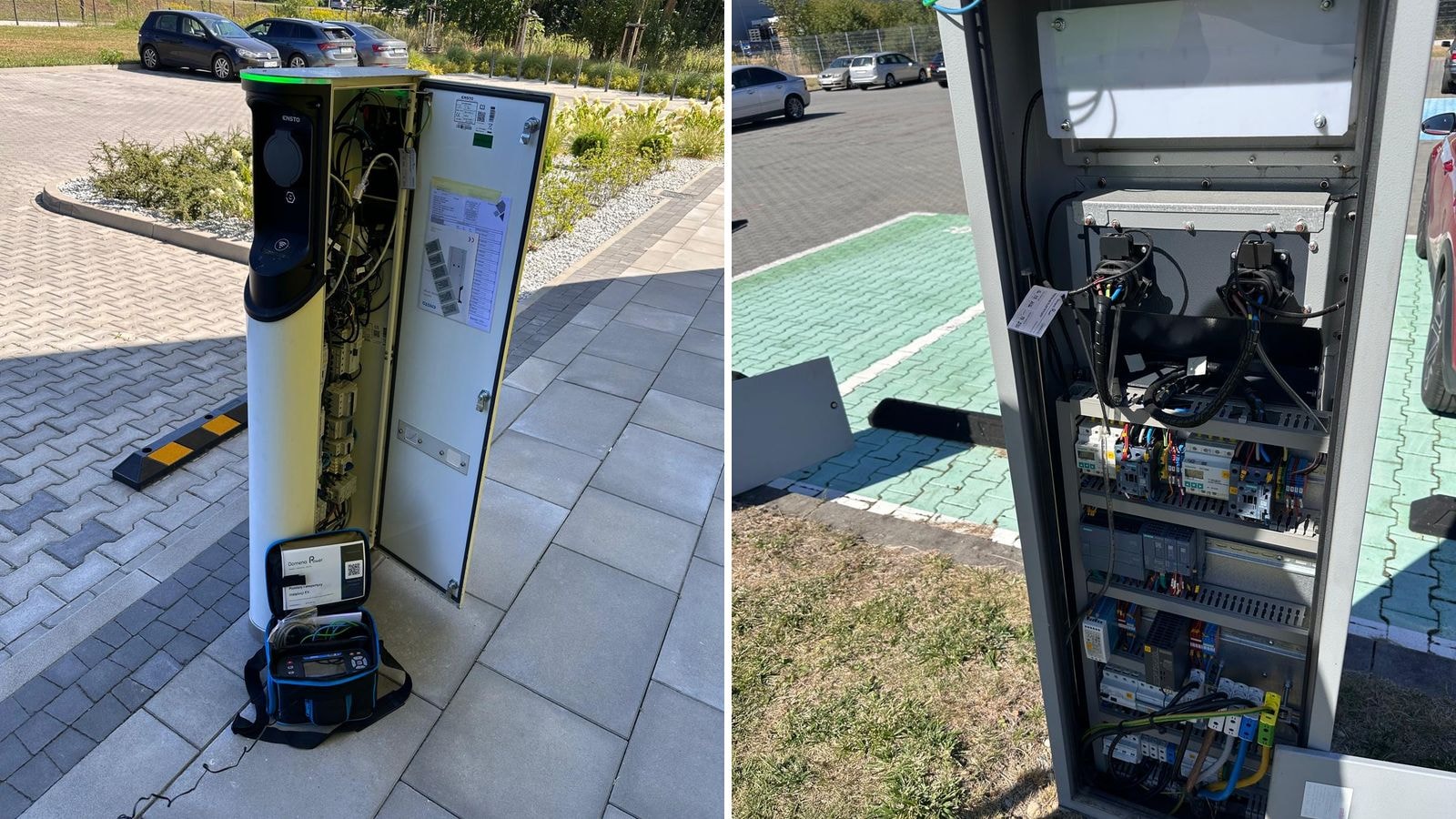
A charging station is an electrical device that works every day, often outdoors, under heavy load. Regular charging station servicing, remote diagnostics and periodic measurements reduce downtime and keep the installation safe. We explain what an inspection covers, how often to carry it out and which tests are mandatory in Poland.
What a charging station inspection covers
An inspection is more than a glance at the housing. The technician opens the station and checks both the electrical components and the parts the driver uses. The typical scope:
- Visual inspection of the housing, seals, cable glands and mounting — especially for outdoor stations exposed to moisture, dust and UV radiation.
- Checking the charging sockets and cables (Type 2): the condition of contacts, insulation, latches and cable strain relief.
- Tightening the terminals in the station’s distribution board and checking for signs of overheating on wires, contactors and terminal strips.
- Testing residual current devices (RCDs) and checking overcurrent protection.
- Electrical measurements: effectiveness of shock protection, insulation resistance, earth fault loop impedance, RCD tripping time and current.
- Verification of energy meters, the controller and connectivity with the management system (OCPP).
- A charging test on every point, plus software and configuration updates.
- An inspection and measurement report, and an entry in the device’s service log.
How often: legal obligations vs recommendations
It is worth separating two things: what the regulations require and what follows from good operating practice. The legal minimum is not always enough to keep a charger running without failures.
- Building Law (Prawo budowlane): a periodic inspection of the building, including testing of the electrical and lightning protection installations, at least once every 5 years. The charging station and its power supply are part of this installation.
- UDT inspections: before the station is put into service and after every repair or modification (e.g. adding charging points or changing the location) — where the station is subject to technical supervision by UDT, Poland’s Office of Technical Inspection.
- Manufacturer’s recommendations: the charger’s manual often specifies its own inspection and maintenance cycle — skipping it may affect the warranty.
- Good practice: a service inspection every 12 months, and every 6 months for intensive commercial use or outdoor stations.
We set the inspection schedule and the scope of mandatory tests for each specific site — they depend on the type of station, how it is made available and the manufacturer’s recommendations.
Is my charger subject to UDT inspection?
The obligation to have UDT technical inspections comes from Poland’s Act on Electromobility and Alternative Fuels. The key question is who you make charging available to, and on what terms:
- Publicly accessible station (available to any driver) — subject to UDT inspection, and the operator registers it in EIPA, Poland’s Alternative Fuels Infrastructure Register.
- Non-public station on which a charging service is provided (e.g. paid charging for tenants, hotel guests or residents) — also subject to UDT inspection, without the obligation to register in EIPA.
- Private charging point used for your own needs (e.g. a wallbox in a house garage) — not subject to UDT inspection, but still requires correct installation, measurements and periodic inspection of the installation.
Why remote diagnostics matter
A charger connected to a management system (via OCPP) continuously reports its status, errors and alarms. As a result, many faults — a frozen controller, a communication error, incorrect configuration — can be identified and fixed remotely, without a technician visit.
Remote monitoring also makes it possible to catch problems before a user reports them: repeated interrupted sessions, protective devices tripping or loss of connectivity. The prerequisite is a stable connection — in underground garages, an M2M SIM card with an external antenna works well.
Obligations of the station owner and operator
Responsibility for safe operation lies with the entity operating the station — the property owner, property manager, housing community or operator. In practice, this means:
- Keeping the station and its power supply in proper technical condition and commissioning periodic inspections and measurements.
- Keeping documentation: measurement reports, UDT decisions and reports (where applicable), and the service log.
- Submitting the station for UDT inspection after repair or modification of a station under technical supervision (replacing parts with identical ones does not require re-inspection).
- Taking out of service any station with visible damage to the socket, cable or housing until it is repaired.
What servicing looks like at Domena Power
We combine monitoring and remote diagnostics with field service. A service request first goes to remote analysis; if the problem cannot be solved online, a technician comes on site with a diagnosis and the parts.
For sites with multiple charging points, we offer a service agreement with an SLA: scheduled inspections and measurements, software updates in agreed maintenance windows and a complete inspection history. We service stations from various manufacturers — including ones we did not install.