Domena Power
Law and obligations

EV charging point requirements for car parks in 2026

4 min readupdated

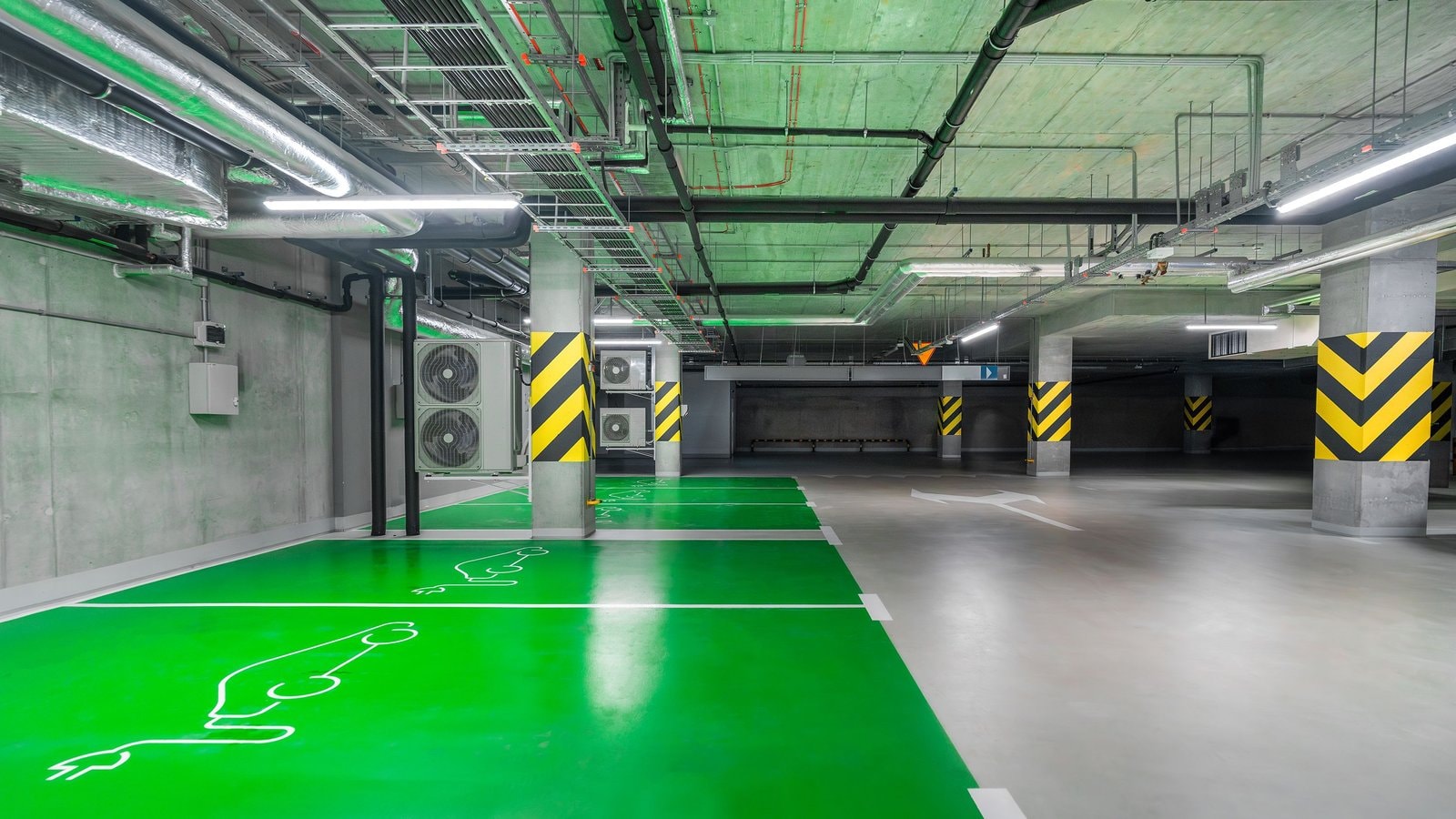
An underground car park with green-marked parking spaces for charging electric carsFot. Jakub Zerdziecki

With larger car parks and new developments, the question of the obligation to provide charging points keeps coming up. We set out the situation in Poland as of 2026: who is covered by the current provisions of the Electromobility Act, who is exempt, and what the implementation of the EPBD directive will change.

Who the obligation applies to — in brief

  • Existing non-residential buildings with more than 20 parking spaces: at least 1 charging point and cable ducts enabling a point to be installed at at least every fifth space — the deadline passed on 1 January 2025.
  • New non-residential buildings with more than 10 spaces: at least 1 charging point and ducts enabling a point to be installed at at least every fifth space.
  • New residential buildings with more than 10 spaces: ducts for electrical wiring and cables at all parking spaces (passive infrastructure).
  • Buildings undergoing major renovation: the same requirements as for new buildings if the renovation cost exceeds 25% of the building’s value and the cost of the charging installation does not exceed 7% of the renovation cost.

Non-residential buildings: the 20-space threshold

Since 1 January 2025, the owner or manager of an existing non-residential building with more than 20 parking spaces should provide at least one charging point and cable ducts that will allow a point to be installed at every fifth space in the future. This applies to office buildings, hotels, retail and service premises, among others.

What counts are the spaces associated with the building — located inside it (e.g. an underground car park) or adjacent to it. Simply having a car park does not settle the matter; you need to count the spaces assigned to the building.

Who is exempt

  • Non-residential buildings owned by small and medium-sized enterprises — the obligations for non-residential buildings do not apply to them.
  • Buildings entered in the register of historic monuments — installation requires the consent of the regional heritage conservator.
  • Renovations where the cost of the charging installation would exceed 7% of the total renovation cost.

New residential buildings: passive infrastructure

In new residential buildings with more than 10 parking spaces, the regulations require ducts for electrical wiring and cables at every space. Chargers don’t have to be installed straight away, but it must be possible to install them later without breaking into the car park structure.

In practice, the developer makes the car park charging-ready at the construction stage. Designing this with power headroom and space in the switchboard is much cheaper than alterations after the building is handed over — and the ready infrastructure makes it easier for the housing community to install chargers later.

What the EPBD directive changes

Directive (EU) 2024/1275 on the energy performance of buildings (EPBD) goes further than the current Polish regulations. The deadline for transposing it into national law passed on 29 May 2026, and some of the requirements are to be included in new technical conditions for buildings.

  • New non-residential buildings with more than 5 spaces: at least 1 charging point per 5 spaces, pre-cabling of at least 50% of spaces and ducts for the rest.
  • New residential buildings with more than 3 spaces: pre-cabling of at least 50% of spaces and ducts for the rest.
  • Existing non-residential buildings with more than 20 spaces: by 1 January 2027, at least 1 charging point per 10 spaces or ducts for at least 50% of spaces.

As of September 2026. EPBD requirements apply in Poland only once they are transposed into national law — check the current regulations before starting a project. This article is for information only and does not constitute legal advice.

How to prepare

  • Count the parking spaces associated with the building and check whether the site exceeds the 10- or 20-space threshold.
  • Check whether an exemption applies to you (SME, historic building, cost limit for renovations).
  • Assess the connection capacity and headroom in the switchboard — with a larger number of points, plan for load balancing.
  • In a new development, design to the EPBD standard from the outset: cabling for 50% of spaces and ducts for the rest.
  • Allow for a fire-safety assessment (underground car parks) and check whether the station will be subject to UDT inspection (by Poland’s Office of Technical Inspection) — e.g. if charging will be paid.
  • Decide how to bill for charging: free of charge, by subscription or by consumption — this affects the choice of chargers and system.

Frequently asked questions

  • For existing non-residential buildings with more than 20 parking spaces, the obligation to provide at least one charging point and cable ducts has applied since 1 January 2025.

Related services

We handle the entire process turnkey — see how we can help:

Sources

Read also

Have a question about charging at your property?

Let’s talk

Let’s talk about working together

Call or write — we’ll answer your questions about assessment, installation and charger billing. You can also leave an enquiry in the form beside this.

I am interested in:

You can select several options.

Provide it if you are enquiring on behalf of a housing community or company. Individual clients can leave it blank.

Leave a number if you prefer a call. Otherwise we will reply by e-mail.

Tell us about the project: type of property, number of charging points, location. It helps us prepare a quote.