How to bill residents for EV charging
8 min read

4 min readupdated
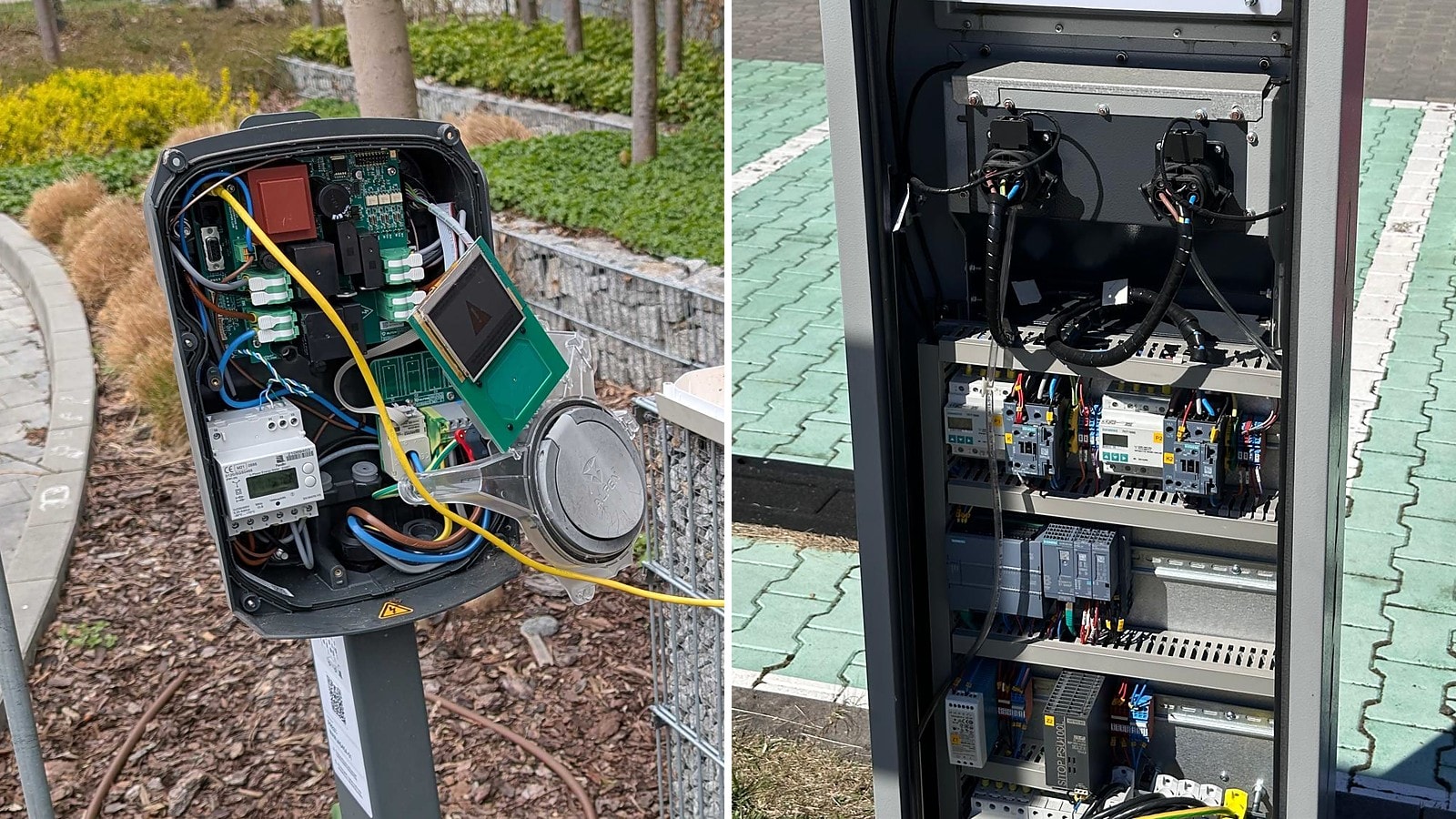
The acronym “MID” keeps coming up in charging billing. It may seem like a technical detail, but it determines whether energy metering is a credible basis for billing residents, tenants or employees. We explain what MID means, how to recognise such a meter and when you really need one.
MID (Measuring Instruments Directive) is EU Directive 2014/32/EU on measuring instruments. It sets requirements for, among other things, active electrical energy meters used for billing. A MID-compliant meter has undergone a conformity assessment involving a notified body, so its accuracy is confirmed, not just declared by the manufacturer.
In practice, this means that a reading from such a meter can be the basis for charging someone for energy — something that cannot be defended in the same way with indicative metering.
In the photo above, on the left: a meter built into a charger, with the “M21” marking next to the CE mark. On the right: a panel in a charging station cabinet with two digital energy meters (P1 and P2) — a separate one for each socket.
A MID meter can be built into the charger or installed separately in the switchboard — in which case the charger reads it via a communication interface. Both solutions are correct; what matters is that each billed charging point has its own metering. For a charger with two sockets, this usually means two meters or one meter that handles both points separately.
The built-in current measurement in the charger’s electronics alone, without a MID meter, is used to control charging and gives an indicative result. It is enough for statistics, but less suitable for passing costs on to others.
The charger reads the meter at the start and end of the session and sends this data via the OCPP protocol to the billing system. The system assigns the session to a user, calculates the cost according to the site’s tariff and compiles everything in reports — monthly, per unit, tenant or employee.
In the event of a dispute, consistency is what matters most: the reading on the meter display, the session history in the system and the amount charged should all match. That is why, during inspections, we also check that the meter is working, sealed and reporting correctly to the system.
Meters used for billing are subject to legal metrological control regulations (Poland’s Law on Measures), which may require re-verification after a certain period. We confirm the requirements for each specific site and billing model individually.
At the equipment selection stage, we establish how the site will bill for charging and choose chargers with a MID meter, or external meters, wherever energy is passed on to other users. In the Domena Power system, each session records the energy used, the time and the rate charged, and the reports are a ready basis for billing — with no commission on energy sales.
We will work out the net and gross amount incl. 23% VAT for your number of chargers.
Number of chargers (sockets)
First socket 30 zł, each additional +10 zł net/month.
External connectivity (LTE SIM cards)
When the charger has no access to the site internet. First card free, each additional +10 zł net/month.
We handle the entire process turnkey — see how we can help:
8 min read
4 min read
4 min read
Call or write — we’ll answer your questions about assessment, installation and charger billing. You can also leave an enquiry in the form beside this.