Domena Power
Charging in practice

EV charging in a housing community: a plan for the board

10 min readupdated

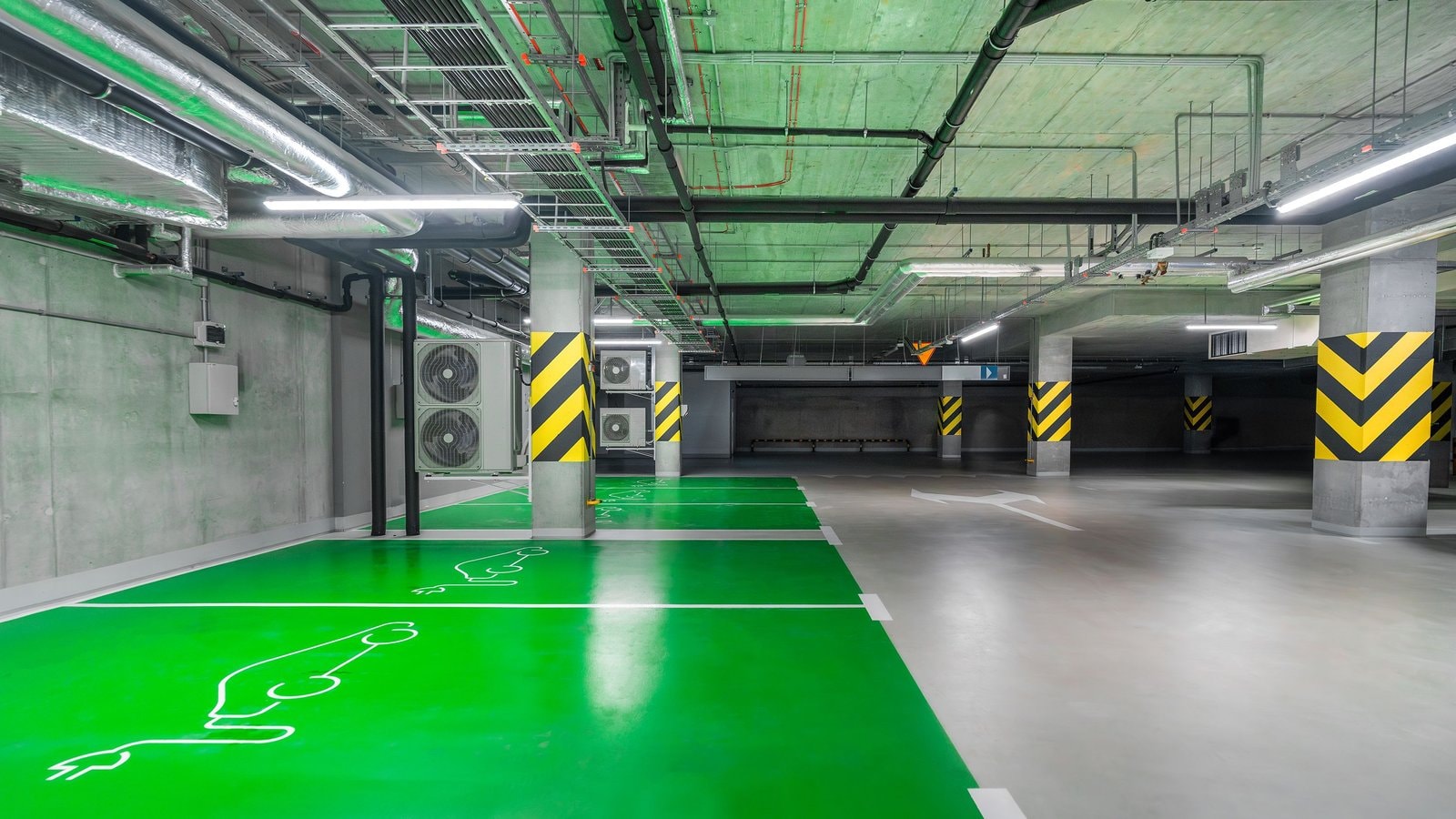
Underground garage of a multi-unit building with parking spaces prepared for charging electric carsFot. Jakub Zerdziecki

The first electric car in the garage usually means one application for a charger. The next ones arrive sooner than the board expects, and if each is handled separately, within a few years the building has a tangle of cables, no spare power left — and no way to connect the next residents who want to charge. This guide is for the board of a housing community or housing co-op: how to take the initiative, gauge demand with a three-question survey, build one installation with MID meters and dynamic load balancing, share the costs fairly and manage it all remotely.

Why the board should act before the applications arrive

Poland’s Electromobility Act gives a resident the right to a charger in their own parking space. Each application starts a separate procedure: the board has 30 days to commission an assessment, and it cannot refuse consent on any grounds other than those listed in Article 12b. With several applications, each new one gets less spare power, and separate cables from the flats’ meters run through ceilings and stairwells.

A board with a plan answers the first application differently: “join the shared installation”. A shared system does not take away anyone’s rights under Article 12b, but it offers a cheaper and simpler route — one set of documentation, one switchboard and billing that runs itself.

The target model: chargers with MID meters on dynamic load balancing

The installation that works best is one where a single measurement serves two purposes. The MID meter at each charger provides the reading used both to control power and to bill the resident. As a result, the building does not need separate systems for control and for billing.

  • A shared charger switchboard supplied from behind the common-area (ADM) meter, and cable routes run along the parking spaces.
  • Each charger has its own MID-certified energy meter, either built in or in the switchboard.
  • Dynamic load balancing (DLB) reads the building’s load and the charger meters, then shares the free power between the cars that are charging at that moment.
  • Readings are sent via the OCPP protocol to the Domena Power system, which assigns sessions to units, calculates charges and lets you manage the chargers remotely. The MID meter can also be read manually at any time, e.g. during an inspection or when a charger is temporarily offline.
  • Chargers are added in stages as the number of cars grows, without repeating the design.

Step 1: a three-question survey

Before the board orders a design, it needs numbers, not opinions from a meeting. The fastest way to get them is a short survey: three questions, and each resident ticks the one that applies to them. It takes a minute, so most units respond. Add only the unit number and the parking space number to the survey.

  • Question 1: “I declare that I will install a charger in my parking space and take up power once the documentation is ready.” This is a binding declaration: the designer reserves power for these points, and the resident orders the charger once the documentation is complete. These answers show current demand and define the first stage.
  • Question 2: “I plan to charge a car in the building, but I am not declaring an installation yet.” The resident takes up no power now and orders nothing, but their space is included in the design. These answers set the reserve, i.e. how many points the cable routes, switchboard and documentation should be designed for.
  • Question 3: “I am not interested in charging in the building.” This answer matters just as much: it separates lack of interest from no reply and helps choose a cost split in which units without cars do not pay in permanently.

Step 2: from survey to numbers — demand today and reserve for tomorrow

Example: a building has 72 units and 60 garage spaces, and 48 units returned the survey. 8 residents declared a charger installation and power take-up, 16 plan to charge in the building without a declaration, and 24 units are not interested in charging in the building. The first stage is 8 chargers, and the infrastructure is designed for 24 points (8 + 16), i.e. 40% of the spaces.

Energy is not the problem here. An electric car driven in the city typically uses 150–250 kWh a month, or around 6–8 kWh a day. So 24 cars need a total of around 170 kWh overnight. If the building has 30 kW of free power at night, over 8 hours it can deliver 240 kWh to the chargers — with room to spare. With a rigid allocation, the same 24 points at 11 kW each would take up 264 kW, many times more than a typical grid connection provides.

  • Power reserve: an assessment of the connection capacity based on meter data and measurements of the building’s load over the course of the day.
  • Space reserve: a switchboard with free slots and cable routes for the target number of points.
  • Documentation reserve: a collective assessment and design for the target number of points from the outset, so further chargers can be added without a new procedure.

An illustrative calculation. The available power and the simultaneity factor are determined by the designer after a power assessment of the specific building.

Step 3: the resolution and charging regulations

Shared infrastructure for many residents goes beyond ordinary management, so a housing community needs a resolution of the owners, and a housing co-op needs a decision by its governing bodies in line with its statute. The resolution settles the investment, and the regulations describe the day-to-day rules.

  • Scope of the investment and source of funding: the repair fund, advance payments from interested residents or a mixed model.
  • Rules for further residents joining: who orders the charger, who installs it and whether a connection fee applies.
  • The community’s MID meters as the basis for billing, and how readings are passed on and debit notes issued.
  • The charging tariff: a rate per kWh equal to the cost of buying energy, possibly with a share of the system upkeep costs.
  • Safety and inspections: who commissions periodic measurements and servicing. Individual chargers assigned to a single unit are not subject to UDT inspections — these apply only to shared points, e.g. a charger for guests.

The community’s MID meters: the basis for fair billing

The meters at the chargers are part of the shared installation and belong to the community. It is the community that, by resolution, recognises them as the basis for billing residents and ensures they remain metrologically valid. MID conformity assessment replaces initial verification, and re-verification must be scheduled within the period set by the regulations on measures.

Readings do not require a walk round with a clipboard. The charger sends the meter reading from the start and end of each session to the Domena Power system, and the board receives a per-unit statement, ready for a debit note. The submeter total also shows how much of the energy on the ADM invoice is for charging and how much for the common areas, so the cost split is clear to everyone without extra work for the administration.

Meters used for billing are subject to legal metrological control regulations (Poland’s Law on Measures). We confirm the requirements for each specific billing model individually.

Who pays for what

  • Survey, power assessment, collective assessment and design — the community. This prepares the whole property and increases its value, including for units without cars.
  • Shared infrastructure (switchboard, cable routes, DLB controller) — according to the model chosen in the resolution (see below).
  • The charger with a MID meter and the cable run to the parking space — the resident who uses it.
  • Energy — each user according to the readings of their own MID meter, at the charging tariff.
  • The Domena Power system — a fixed subscription per charger, most simply added to the charger user’s fee.
  • Inspections and servicing — from charger users’ fees or from the community’s budget, as set out in the regulations.

How to share the cost of the shared infrastructure

The documentation cost per point falls as the number of points grows. At Domena Power, a collective assessment with design for one building costs 4,000 zł net for the first point and 500 zł net for each additional one — for 8 points, that is 7,500 zł net, or 937.50 zł net per point. Approval by a fire-safety expert can be added as an option (from 1,000 zł net, one-off, depending on the building type). From 20 points, e.g. the 24 points in the example, we set the price individually.

  • The community funds everything, e.g. from the repair fund. The fastest option: the infrastructure is treated like a lift or an intercom. The downside: units without cars contribute too, which is why it is usually combined with a connection fee.
  • Interested residents pay. The cost is shared by the residents in the first stage. Fair, but a high entry threshold can be off-putting and slow down further sign-ups.
  • Mixed model (recommended). The community funds the documentation and the core of the installation, and each resident who joins pays for their own charger and a one-off connection fee, which over time pays back the community’s outlay. Residents without cars do not contribute permanently, and the pioneers do not pay for the whole building.

Documentation prices are net, indicative for one building connected to an existing switchboard. You will find the current price list and documentation calculator on the “Assessments and designs” page (linked under “Related services” below the article). This article does not constitute legal advice — it is worth consulting the cost-sharing rules with your property manager or a lawyer.

How to stay on top of it day to day

Most of the work in a building with chargers is not the installation but the day-to-day running: readings, debit notes, new users, sold flats and questions like “why is my car charging more slowly?”. With the Domena Power system, the board or property manager handles all of this from a single panel.

  • Remote MID meter readings and per-unit reports, ready for debit notes or for transfer to a property administration system (including Betasi).
  • Permissions: a charger assigned to a unit, with access granted or revoked in one click, e.g. when a flat is sold.
  • An overview of power and DLB settings: limits for the building or a group of chargers, and peak-load charts.
  • Alerts and remote servicing: online/offline status, error history, reset and connector unlocking without a technician’s visit.
  • An app for residents showing the cost of every session, so fewer questions for the property administration.
  • Connectivity even in an underground garage — via an M2M SIM card, with the first one included in the subscription.
  • Manufacturer independence: the system supports chargers that use the OCPP protocol.

How to expand the installation in the years ahead

  • Repeat the survey every year — the same three questions show the trend and tell you when to order more chargers.
  • Connect new chargers to the existing switchboard under the documentation prepared for the target number of points.
  • After each stage, check power utilisation in the panel and adjust the DLB limits if needed.
  • When your energy contract changes, recalculate the tariff: night-time charging often makes a two-zone tariff the better choice.
  • Consider community photovoltaics as the next stage — energy from the roof used in cars is worth more than energy sold to the grid.
  • If a charger for guests or one shared by several people is needed, remember that a shared point is subject to a UDT inspection.

Domena Power: one partner from survey to billing

You do not have to coordinate five companies. Domena Power takes the community through the whole process: from the power assessment and collective assessment, through installing chargers with MID meters and dynamic load balancing, to the billing system and servicing. The community becomes its own charging operator — it sets the rates and access rules itself, and pays a flat subscription for the system with no commission on energy: 10 zł net a month for every charger, with no higher rate for the first one. For 8 chargers, that is 80 zł net a month.

To get started, the three questions from this article are all you need. Get in touch with your survey results — we will prepare a power assessment and a staged plan for your building.

Subscription prices are net, excluding VAT. From 20 charging points, we prepare an individual quote.

Frequently asked questions

  • No. The grounds for refusing consent to a charger for individual use are listed in Article 12b of the Electromobility Act, and a plan for a shared installation is not one of them. The shared system is an offer to the resident: usually cheaper and simpler than a separate procedure.

Related services

We handle the entire process turnkey — see how we can help:

Sources

Read also

Have a question about charging at your property?

Let’s talk

Let’s talk about working together

Call or write — we’ll answer your questions about assessment, installation and charger billing. You can also leave an enquiry in the form beside this.

Office

Working days, 8:00–18:00

Technical support

Every day, 8:00–22:00

I am interested in:

You can select several options.

Provide it if you are enquiring on behalf of a housing community or company. Individual clients can leave it blank.

Leave a number if you prefer a call. Otherwise we will reply by e-mail.

Helps us plan the travel to your site.

Tell us about the project: type of property, number of charging points, location. It helps us prepare a quote.