EV chargers in underground garages: fire safety
4 min read

8 min readupdated
 Fot. Jakub Zerdziecki
When chargers are about to appear in a garage, housing community boards and property managers often want to play it safe: buy a fire blanket, add sprinklers above the charging bays, put up partitions between spaces or fit a red emergency switch at every charger. Some of these ideas do not improve safety, and some make it worse. We explain what not to do on your own initiative, what makes no sense and what fire protection in a garage with chargers really rests on.
A garage’s fire safety follows from its design: the division into fire zones, ventilation and smoke extraction, escape routes, the fire alarm system (SSP, where there is one) and the fire-fighter’s power cut-off switch (PWP). These elements are interlinked and described in the building’s fire safety instructions — changing one affects the others.
That is why any change affecting these conditions should be assessed by a certified fire-safety expert. The guidelines for garages with electric-car charging issued by CNBOP-PIB (the Polish Scientific and Research Centre for Fire Protection), the National Headquarters of the State Fire Service (PSP) and the Polish Association of New Mobility (2nd edition, 2025) are not legislation, but their direction is clear: early fire detection, limiting fire spread and good conditions for rescuers — matched to the risk of the specific building, not taken from a just in case list.
Discussions about garage fire protection mix up three kinds of requirements that carry very different weight:
It also works the other way round: if a building cannot meet a legal requirement, an alternative solution may be used — based on a fire-safety expert’s report agreed with the regional commander of the State Fire Service (Article 6a of the Fire Protection Act). Such a solution must not worsen the building’s fire protection conditions.
In this light, no regulation requires a fire blanket, sprinklers above the chargers only, partitions between bays or red buttons at every charger just because charging is added to a garage. Such measures can appear in the design as the expert’s recommendation or the investor’s choice matched to the building’s risk. They become mandatory only as part of an alternative solution agreed with the State Fire Service — they then replace a legal requirement and must be implemented.
An ordinary fire blanket, like the one in a kitchen or office, is meant for small fires — a frying pan or clothing. It is simply too small for a car.
For cars, large fire blankets are used: they measure several dozen square metres, weigh around 30 kg and take at least two people to deploy. The fire service tests them and increasingly carries them, and PSP experts point out that they can be part of a garage’s equipment — for on-site staff who, in the first phase of a fire, isolate the burning vehicle from neighbouring ones. However, a blanket does not extinguish a fully developed battery fire (cells in thermal runaway produce their own oxygen), and rescue procedures do not name it as a means of extinguishing.
The problem starts when the blanket hangs in a housing community’s garage for residents:
A sprinkler system in a garage works. Research and fire-service experience show that water lowers the temperature around a burning car and limits the spread of fire to neighbouring vehicles. The problem is not the idea itself but a shortcut execution: a few sprinkler heads above the charging bays, connected to the building’s water supply.
Partitions made of boards, sheet metal or mesh between bays look like a simple way to fence off electric cars. But such a partition is not a fire separation, and it can make conditions in the garage worse:
PSP experts point to fixed fire-extinguishing systems and local fire separations as ways of limiting fire development in its early phase — especially where charging points are densely concentrated, in hard-to-reach parts of the garage and on underground levels.
The difference is that these are solutions based on a risk analysis: designed and approved by a fire-safety expert, built from products with proven fire resistance or as a complete extinguishing system linked to the building’s fire alarm system. They are not an add-on put up in passing while installing chargers.
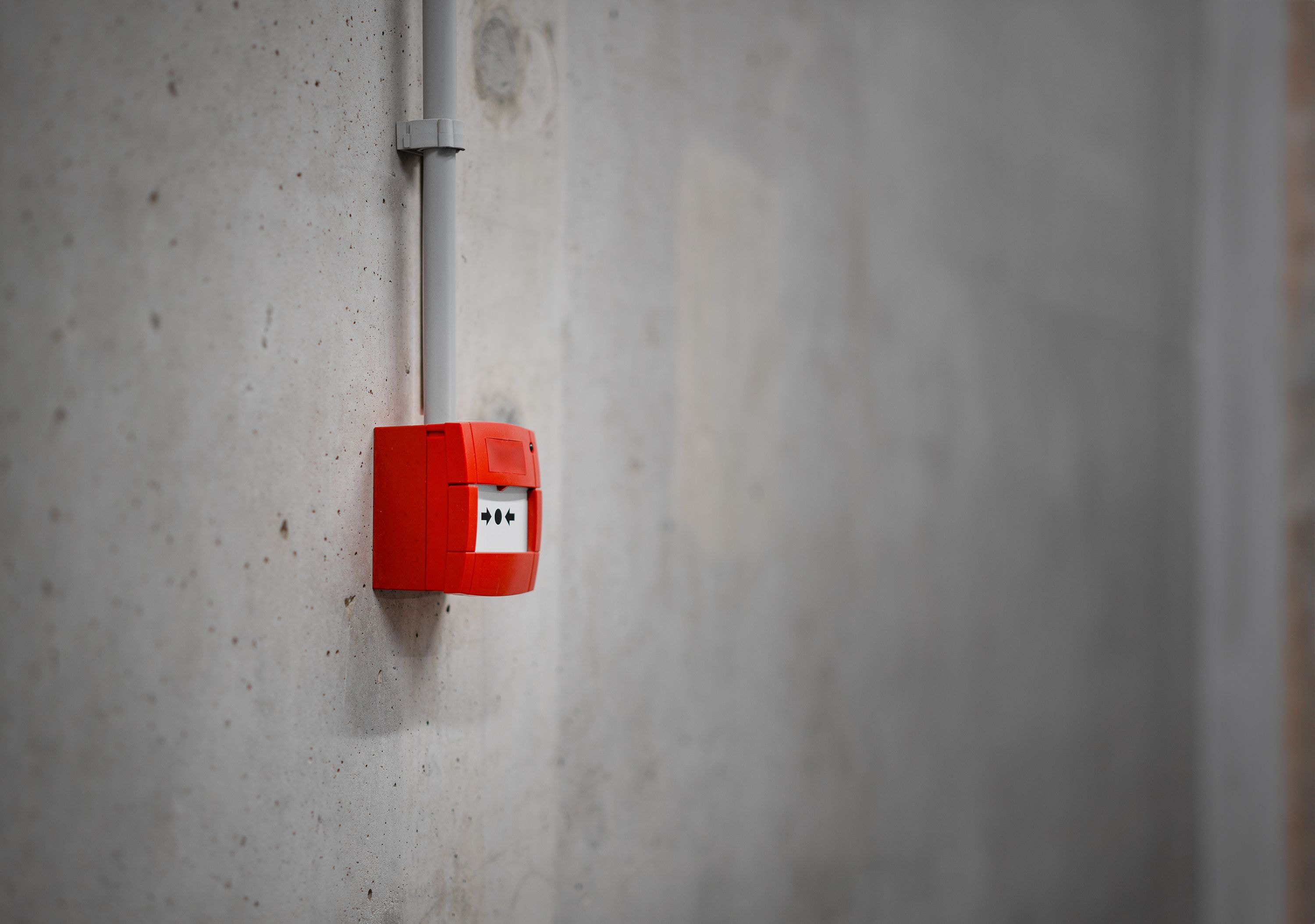
A red emergency button at every charger seems like an obvious safeguard. In a building with a fire-fighter’s power cut-off switch (PWP), it usually adds nothing. In Poland, a PWP is required in fire zones with a volume above 1,000 m³ (§ 183 of the technical building regulations); it is located at the main entrance or the supply connection, it is signposted — and it is what the fire service uses. In garages with a fire alarm system, the chargers’ power supply is additionally cut automatically after an alarm.
The scope of protection depends on the building, the number of charging points and the existing installations — it is determined by a fire-safety expert after analysing the building. This article does not replace a fire-safety opinion.
Enter the number of charging points and we will calculate the net and gross amount incl. 23% VAT.
Additional points within a single documentation set are cheaper: the first point is the full assessment and design, and each further one is only +330 zł net — the more points, the lower the cost per point.
Number of charging points
First point 3000 zł, each additional +330 zł net.
* Applies to connection to the building’s existing distribution board, provided the full required electrical documentation and floor plans are supplied.
We handle the entire process turnkey — see how we can help:
4 min read
4 min read
2 min read